Marking That Survives Shotblasting, E-Coating & Heat Treatment
Traceability only works if the code is still readable at the end of the line. Shotblasting normally erases direct part markings. With the right cell size/depth marking ratio, blast particles can’t damage the code readability.
Laserax sizes the data matrix to match your specific blasting media using a custom process. That means die cast parts can hold traceability from die extraction all the way to the assembly line.
Learn more…
Markings also need to remain legible through e-coating, powder coating, and heat treating. We can help you integrate a process that will resist post-treatment processes.
Learn more…
Laser Safety: Class 1 vs. Class 4 in Production
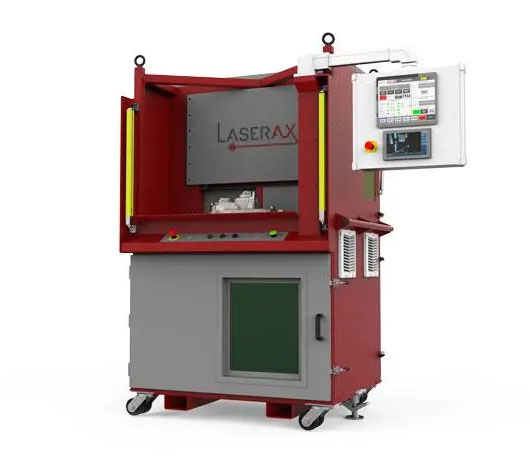
With a Class 1 turnkey machine, operators need no protective eyewear, no restricted laser area, and no separate safety program. The machine arrives compliant and drops into an existing line.
Integrating an open-beam Class 4 laser marker means the responsibility shifts to you: appointing a laser safety officer, training personnel, installing barriers, curtains, interlocks and signage, and supplying eyewear rated for the specific wavelength. That work is worth doing when the laser has to be embedded in a larger automated cell.
How Much Does an Industrial Laser Marking System Cost?
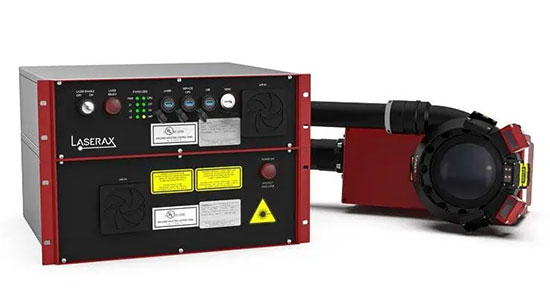
An industrial laser marking system starts at around $35,000 to $40,000 for a standalone laser marker (a laser source, scanner, and controller you integrate into your own line or enclosure).
A complete turnkey machine costs more because it includes the Class-1 enclosure, dust and fume extraction, part handling, safety certification, and software. Manually loaded workstations start at roughly $120,000, and higher-throughput configurations like a rotary table start closer to $230,000. Fully automated robot and conveyor cells are quoted per application.
Most of the variation comes from four things: laser power, automation level, safety and certification requirements, and options like autofocus, vision systems, and barcode validation.
Higher power costs more but buys back cycle time, which is usually the deciding factor on an inline application.