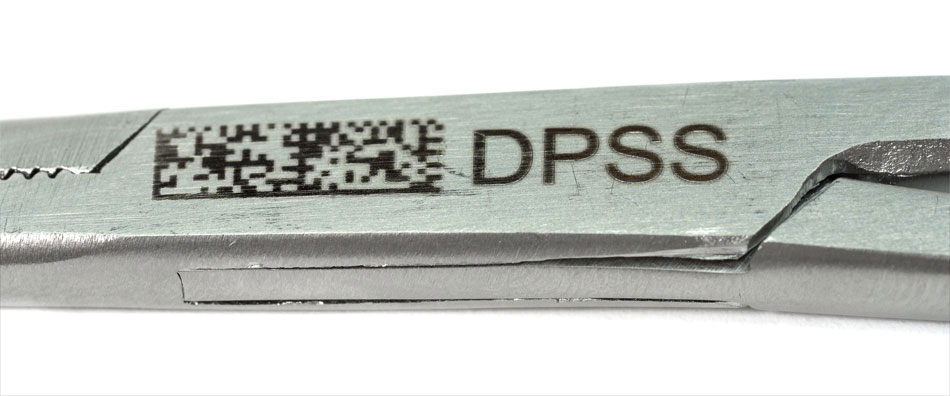
In an industry shaped by strict regulations, globalized manufacturing, and increasing patient expectations, the ability to know exactly where a device has been, how it was made, and where it is going has become essential.
From Unique Device Identification (UDI) requirements to real-time production monitoring, organizations are under growing pressure to connect data across every stage of the product lifecycle.
This article explains the differences between medical device tracking and traceability, outlines FDA UDI requirements, reviews common marking methods, and provides practical steps to implement tracking or traceability with lasers.
Tracking is a way to easily provide users and consumers with information about a medical device so they can use it in the safest way possible. For end users, this can include the expiration date, lot or serial number, as well as QR or Data Matrix codes that give access to more information.
Why is it important?
By allowing manufacturers to communicate important information to users effectively, tracking ensures the device is used correctly and in compliance with regulatory requirements.
Medical Device Traceability
What is it?
Medical device traceability provides a record of a device’s history, location, and use across its entire lifecycle, from raw materials and manufacturing to patient use.
Whereas tracking is destined for external use, traceability is intended for internal purposes. It typically involves smaller codes (0.5 mm x 0.5 mm or smaller) barely visible to the naked eye.
Why is it important?
Traceability helps identify problems quickly and precisely. It also reduces the risk that counterfeit or faulty products enter the supply chain, which contributes to patient safety.
Through the use of a Unique Device Identifier (UDI), traceability ensures that the devices are compliant with the Food and Drug Administration (FDA) and international regulations.
The codes contain valuable information, such as country of origin, site location, and production line identification. This allows for improved recall management, as well as the identification and removal of affected devices from the supply chain.
Traceability facilitates data collection from the field, which helps evaluate the performance of the device and identify opportunities for improvement.
FDA Requirements for Traceability
For medical devices, several types of regulations apply to different regions, countries, and manufacturers. The most commonly used system is the Unique Device Identifier (UDI)
Used by the FDA and other regulatory bodies, a UDI is a unique numeric or alphanumeric code assigned to a medical device. It allows for the easy identification of specific devices on the market and facilitates their traceability throughout their lifecycle.
UDIs are usually made of two parts:
Device Identifier (DI): The UDI-DI is mandatory and fixed. It identifies the labeler, which is typically the device manufacturer, and the version or model of a specific device.
Production Identifier (PI): The UDI-PI is conditional and variable. It may include the device’s lot or batch number, serial number, expiration date, manufacturing date, or distinct identification code.
The UDI is used internationally, but the specific rules, databases, and implementation processes vary depending on the jurisdiction.
In the United States, the FDA has determined that the UDI is mandatory for most medical devices. The FDA requires labelers to do the following:
Include a UDI on all device labels and packages (with limited exceptions).
Enter all device information in the Global Unique Device Identification Database (GUDID), where it can be accessed by anyone, including manufacturers, patients, health care providers, and regulators.
On a device label, the UDI appears in both plain text and in machine-readable format.
Common Methods for Medical Device Traceability
Laser Marking
Laser marking is a process that uses a focused beam of light to permanently alter the surface of an object. Various types of lasers, such as UV, fiber or CO₂ lasers can be used for marking.
For traceability (and other purposes), laser marking has proven to be a highly reliable method. Though it requires a larger upfront investment than the alternatives, it yields better returns on investment (ROI) than most other methods after a year, since the process requires no consumables.
In addition to being economical and eco-friendly (again, since it eliminates the need for consumables), laser marking provides the following advantages:
It is the fastest and most efficient option for traceability.
The markings are permanent and highly precise.
Laser marking can be used on metals, plastics, polymers, and more.
The marks are resistant to sterilization, chemicals, and wear.
Because of its high precision, laser marking ensures the UDI codes (Data Matrix) are of very high quality.
If the medical device is to be placed inside the body and must have identifying marks, laser marking is the only option.
Pad Printing
Pad printing, which is also called tampo printing or tampography, is a process that transfers a 2D image onto a 3D object using an etched plate and a silicone pad.
This technique is sometimes used for its ability to create high-contrast markings and to produce color images.
However, pad printing has several limitations: it tends to smear and leave blotches, is restricted in code size, cannot produce very small markings, and must be operated manually.
Labels and Barcodes
Labels and barcodes are commonly used as they are cost-effective and easy to produce and use. But because they can wear over time, may not withstand sterilization, and are prone to detachment, they might not remain reliable and effective over time.
Plus, the fact that they are limited in size can also make them unsuitable for certain devices.
Dot Peen Marking
Dot peen marking is a process that uses a tungsten carbide stylus to strike the surface of an object, with each impact creating a dot and the movement of the stylus forming lines of dots that can produce numbers, codes, dates, logos, or 2D Data Matrix codes.
Though this technique produces durable results, it is limited in that it can only be used on metals, can cause surface damage, lacks precision, and requires more maintenance than most other options.
How to Implement Effective Tracking or Traceability with Lasers
Start by identifying the standards that apply to your devices, such as UDI, FDA, MDR, or ISO 13485. From there, determine what data must be included (typically UDI information, lot or batch numbers, serial numbers, and expiration dates).
It’s also important to define durability requirements, ensuring that markings remain legible after sterilization, cleaning, and throughout the product’s lifecycle.
Finally, establish readability expectations by selecting machine-readable formats like Data Matrix or QR codes and aligning with grading standards.
Step 2: Select Materials & Marking Locations
Next, evaluate your materials to determine the most suitable laser technology. UV lasers are generally preferred for plastics and sensitive materials, while fiber lasers are often better suited for metals.
Choose marking locations that are easy to access and scan without interfering with the device’s functionality.
Ensuring strong contrast between the mark and the surface is key to reliable readability.
Step 3: Define Code Format & Data Structure
Once materials and placement are defined, select the appropriate code format. Most medical device applications rely on 2D Data Matrix or QR codes, following GS1 or HIBCC standards.
The code size should be optimized based on available space while maintaining readability. If required, include human-readable text alongside the code.
Step 4: Configure the Laser Marking Process
With the code defined, configure the laser parameters (power, frequency, and speed) based on the material being marked. The goal is to achieve high-contrast, precise marks with minimal thermal impact.
The help of a laser expert is highly recommended for this step.
Step 5: Integrate Marking into Production
To streamline operations, integrate the laser system with your systems. This enables automated code generation, serialization, and data management.
Proper integration also ensures that marking aligns with production flow, helping to avoid slowdowns or bottlenecks.
Step 6: Verify Code Quality & Readability
Finally, implement a verification process to ensure every code meets quality standards. Use vision systems or scanners for inline inspection and grade codes according to ISO requirements.
Establish clear pass/fail criteria and define rework procedures to maintain consistent traceability and compliance.
Are you a Medical Device Manufacturer?
If you’re looking to implement or improve your tracking and traceability system with laser technology, our team can help.
From material testing and application expertise to system integration, we’ll support you at every step. Get in touch to explore the best solution for your application.
As a business development manager, John has extensive experience and expertise in laser solutions across several industries, including medical, food & beverage, packaging, semiconductor, industrial automation, and aerospace.
Every printed circuit board that leaves a fabrication line needs to be traceable to its source. Traceability data (serial numbers, lot codes, Data Matrix symbols) must survive assembly, reflow, cleaning, coating, and years of field service, all while fitting within a marking area smaller than a grain of rice.
Semiconductor manufacturing requires incredible precision. In an industry where one micron is considered large, even minor process deviations can compromise yield or performance. Laser wafer marking is often the best solution, offering non-contact processing with high repeatability and integration into automated workflows.
When precision marking is required on delicate or heat-sensitive materials, ultraviolet (UV) laser technology offers a distinct advantage.
By minimizing thermal impact, UV laser marking creates high-contrast, permanent marks while preserving material integrity and meeting demanding traceability requirements.