Modern catheter systems are becoming smaller, more complex, and more specialized for procedures ranging from cardiovascular interventions to neurovascular treatments. At the same time, these devices must meet extremely strict manufacturing and regulatory requirements.
Because catheters are inserted directly into the human body, manufacturers must maintain tight dimensional tolerances, minimize contamination risks, and ensure consistent performance across high production volumes.
There are strict standards and regulations governing catheter design, testing, and production, including ISO 10555 for intravascular catheter performance, ISO 13485 for medical device quality management systems, and the U.S. FDA’s Quality Management System Regulation under 21 CFR Part 820.
Meeting these requirements while producing highly complex devices at scale presents significant manufacturing challenges. Laser processing enables manufacturers to achieve the precision, repeatability, and automation to meet the most exacting standards.
Traditional methods like mechanical cutting or pad printing can introduce debris, stress, and variability. Laser processing avoids these issues by enabling precise, clean, and repeatable manufacturing.
Non-contact, contamination-free processing
Lasers deliver energy without physical contact, preventing deformation of thin-wall tubing and reducing contamination risk. With no tool wear, they ensure consistent results over long production runs.
Minimal thermal impact with UV “cold” lasers
UV lasers produce extremely small heat-affected zones, allowing precise cutting, drilling, and marking of heat-sensitive polymers and thin metal components without melting, distortion, or structural damage.
Micron-level precision for complex designs
Laser systems operate at the micron scale, enabling the tight tolerances required for modern catheters with complex geometries, multiple lumens, and integrated features.
Higher throughput and process consolidation
A single laser system can perform cutting, drilling, marking, and ablation in one setup, reducing manual steps, improving repeatability, and increasing production efficiency.
Common Laser Processes in Catheter Manufacturing
Although laser technology can support many manufacturing operations, three processes are the most common in catheter production.
1. Laser Marking
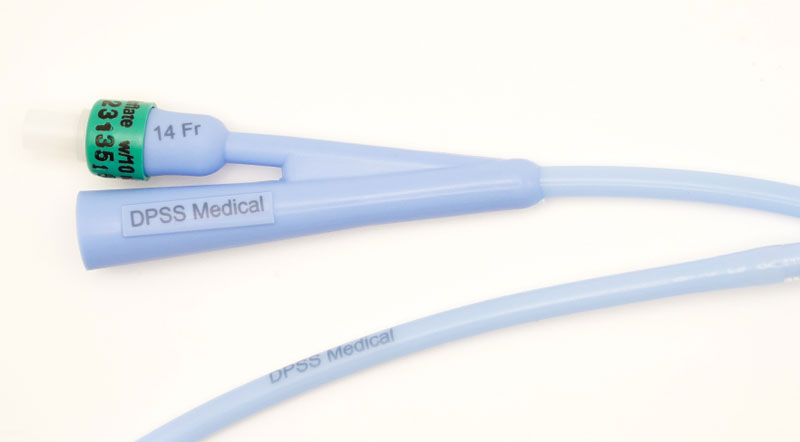
Medical devices require permanent identification to ensure full traceability throughout manufacturing, distribution, and clinical use. Laser marking produces permanent, high-contrast marks by modifying the surface properties of the material.
Unlike pad printing or ink-based methods, laser marks are inherently resistant to wear, chemicals, and repeated sterilization cycles, eliminating the risk of smearing or degradation over time.
Measurement and Depth Markings
Many catheters include measurement indicators along the shaft that allow physicians to monitor insertion depth during procedures. Laser systems can produce these markings with extremely high precision. Using specialized fixtures, multiple features on the catheter assembly can often be marked during a single processing cycle.
Material Interaction and Mark Formation
Laser marking on polymer catheter materials typically occurs through photolytic ablation that alters the surface chemistry of the polymer rather than removing material. This process produces high-contrast markings without damaging the underlying structure of the device.
2. Laser Cutting
Laser cutting enables manufacturers to precisely trim and shape polymer catheter shafts with minimal thermal or mechanical deformation. This results in clean, smooth edges and significantly reduces the need for secondary finishing operations.
Mechanical cutting tools can generate microscopic debris, requiring additional inspection and cleaning steps. Laser cutting reduces this risk by producing smoother edges and more consistent results.
Laser systems are also used to machine metal hypotubes that provide structural support in catheter assemblies. These tubes may require angled tips, precision slits, or other specialized geometries that help control catheter flexibility and steerability. With laser cutting, you get precision with high repeatability.
3. Laser Drilling
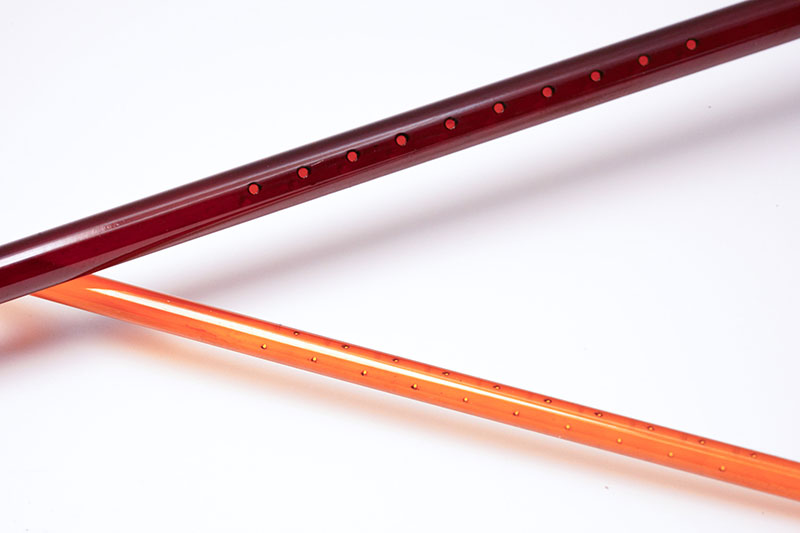
Catheters used for drug delivery or fluid management often require micro-scale openings along the shaft or tip. These holes may serve as irrigation ports or medication delivery channels.
Precise Tolerances
Modern laser systems can produce holes as small as approximately seven to eight microns in diameter, allowing precise control over fluid flow and device performance. With the right process recipe and precision motion control, those holes can be reduced to roughly one micron in specialized applications.
Laser drilling is the obvious choice compared to many manual processes that operate with positional tolerances measured in millimeters rather than microns.
Eliminating Debris
For devices that will be inserted into the human body, minimizing particulate contamination is a critical manufacturing requirement. Mechanical machining can generate loose debris that must be removed before use. This adds to the process, requiring cleaning and inspection.
Laser machining removes material through ablation, vaporizing it rather than mechanically breaking it away. Fume extraction management and post-process cleaning significantly reduce the risk of particles remaining inside the catheter lumen.
Advanced and Emerging Laser Applications in Catheter Manufacturing
In addition to core processing operations, there are a few emerging uses for laser applications in catheter production, including:
Wire stripping: Remove insulation from extremely fine wires used in advanced catheter systems without damaging the underlying conductor. Lasers can strip the polyimide insulation off 50 AWG wire that’s thinner than a human hair without nicking the core, something mechanical blades cannot do reliably.
Balloon bonding: Bonding balloon components directly to catheter shafts, creating strong joints while eliminating adhesives that could introduce additional materials into the device. The hermetic seal it creates is often stronger than the base material.
Reflow and lamination: Laser energy can also be used to heat and reflow outer polymer layers over braided reinforcement structures, creating smooth outer surfaces and consistent device geometry.
Sensor integration for smart catheters: Non-contact laser techniques help expose conductors and prepare connection points without damaging delicate components.
Material Compatibility
Material composition can affect laser performance on catheters. Additives can enhance or hinder marking quality, making early alignment between material selection and laser processing critical.
For example, additives such as titanium dioxide can enhance contrast during laser marking by improving the material’s responsiveness to ultraviolet wavelengths.
Other additives used to improve imaging visibility may reduce laser absorption. For example, materials containing barium sulphate, essential for radiopacity, tend to scatter laser light and make it difficult to achieve dark, high-contrast marks.
Quality Control with Laser Vision Systems
Inspection and verification are essential steps in catheter manufacturing. In most traditional production environments, quality control relies on batch sampling. Operators may inspect only a small number of parts from each production batch. In some operations, it may be as small as two parts out of every thousand produced. While this approach might detect major issues, it certainly doesn’t guarantee that every device meets specifications.
Laser processing systems can integrate machine vision technology directly into the manufacturing cell. High-resolution cameras and inspection software can automatically verify marking position, hole dimensions, and surface quality immediately after processing, allowing manufacturers to inspect every catheter coming off the production line.
Lasers Are Key to Consistent, Efficient Catheter Production
The rapid expansion of minimally invasive medicine is driving demand for increasingly advanced catheter technologies. Manual machining makes it challenging to meet that demand.
Laser processing provides a powerful solution to these challenges.
By enabling non-contact machining, micron-scale accuracy, and automated inspection, laser systems allow manufacturers to produce complex catheter devices with greater consistency and efficiency.
Are You a Catheter Manufacturer?
If you are considering laser in your catheter manufacturing process, contact us to discuss testing, application guidance, and next steps.
As a business development manager, John has extensive experience and expertise in laser solutions across several industries, including medical, food & beverage, packaging, semiconductor, industrial automation, and aerospace.
Although steel is a strong metal, altering its microstructure with a surface treatment can be necessary to improve hardness and wear resistance. In other cases, surfaces must be cleaned to remove oxides, textured to improve adhesion, or coated for protection.
Laser marking is everywhere—from serial numbers on automotive parts to logos on electronics and traceability codes on medical devices. But not all lasers are created equal, and selecting the right type depends on your material and marking requirements.
With their unmatched ability to process materials with high precision and minimal thermal damage, Ultraviolet (UV) lasers have become essential tools across industries as diverse as microelectronics, medical devices, automobiles, and even consumer goods packaging.